October 4, 2026
How Much Does a Concrete Patio Cost in Jacksonville, FL?
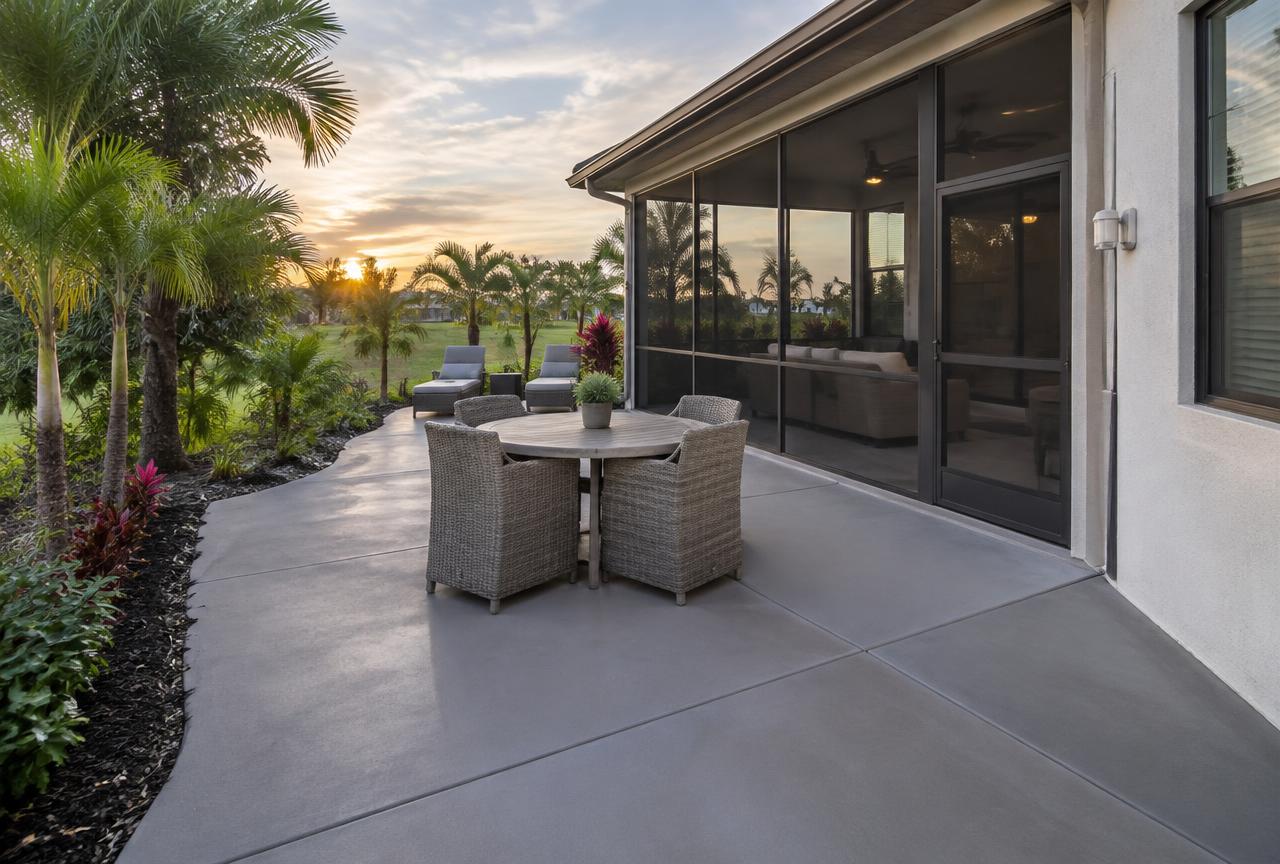
Most Jacksonville homeowners start a patio project with one question: what is this going to cost? The honest answer is a range, because two patios of the same size can be priced very differently depending on what's under the grass, how far the truck has to reach and what finish you choose.
This guide walks through the factors that actually move a patio quote, shows example ranges for common sizes using the same assumptions as our online calculator, and points out the budgeting mistakes we see most often.
What a concrete patio typically costs per square foot
For a standard broom-finished patio on easy-access ground, our calculator plans around roughly $8–$15 per square foot before add-ons. Decorative finishes apply a multiplier on top of that base: colored concrete around 1.3×, exposed aggregate around 1.35× and stamped concrete around 1.45×.
Small patios rarely land at the per-square-foot figure, because every pour carries fixed costs — mobilization, forming, a concrete truck and a finishing crew. That's why a small slab can feel expensive per foot compared with a larger one.
Example costs for common patio sizes
| Patio size | Broom finish | Stamped + sealed |
|---|---|---|
| 10 × 10 ft (100 sq ft) | $1,800 – $2,700 | $1,800 – $2,700 |
| 12 × 16 ft (192 sq ft) | $1,800 – $3,050 | $2,450 – $4,750 |
| 15 × 20 ft (300 sq ft) | $2,500 – $4,750 | $3,850 – $7,400 |
| 20 × 20 ft (400 sq ft) | $3,350 – $6,350 | $5,100 – $9,850 |
Planning ranges from the same assumptions as our online cost calculator (easy access, wire mesh, no demolition unless noted). They are estimates, not quotes — your price depends on an on-site look. Small sizes are held up by a minimum project charge.
The factors that move a patio quote
- Size and shape — curves, steps and many corners add forming time compared with a simple rectangle.
- Site preparation — removing sod, roots and soft fill, then compacting Jacksonville's sandy subgrade so the slab doesn't settle.
- Demolition — tearing out an old patio or pavers adds removal and haul-off (our calculator adds about $2–$4.50 per square foot).
- Access — a backyard behind a fence or a tight side yard may mean a concrete pump or wheelbarrows, which the calculator reflects with an 8–20% access factor.
- Reinforcement — wire mesh or a rebar grid, chosen for how the patio will be used.
- Drainage — grading so runoff moves away from the house, and sometimes rerouting a downspout.
- Finish and sealing — broom, colored, exposed aggregate or stamped, and whether a sealer is applied.
Broom finish vs. decorative patio options
A broom finish is the practical default: good traction when wet, simple to maintain and the lowest cost per foot. Decorative options — color, exposed aggregate, saw-cut patterns and stamping — add materials, labor and in most cases a sealer that needs renewing over time.
Stamped concrete is the most popular upgrade for Jacksonville patios because it can imitate stone or slate. If you're weighing that choice, our stamped concrete cost guide goes into pattern, color and resealing costs in detail.
Small vs. large patios
A 10×10 seating pad and a 20×20 entertaining patio are different projects. Smaller patios carry a higher cost per foot because of fixed costs. Larger patios bring that number down but need more joint planning, more careful grading over a wider area and sometimes a pump if the truck can't reach.
What raises or reduces the cost
- Raises: backyard-only access, tree roots to remove, old concrete to break out, low ground that needs fill, stamped or multi-color finishes.
- Reduces: a simple rectangle, open access from the driveway, a broom finish, and pouring at the same time as other flatwork on the property.
Common budgeting mistakes
- Comparing a bid that includes demolition and base prep with one that doesn't.
- Forgetting drainage — fixing ponding after the pour costs more than grading it right first.
- Choosing a decorative finish without budgeting for resealing every few years.
- Sizing the patio too small for the furniture and grill you actually plan to use.
- Planning a screen enclosure later without telling your contractor, so edges and footings aren't considered.
New patio vs. resurfacing an existing one
If your current patio is structurally sound — no major settling, no broken sections — resurfacing can renew the surface for less than replacement. If it's sunk toward the house, broken into pieces or holding water, a new slab with proper grading is usually the better investment. Our resurfacing vs. replacement guide covers how to tell the difference.
Jacksonville soil and climate considerations
Northeast Florida's sandy soils drain fast but shift when they wash out, so compaction and edge support matter. Summer storms drop a lot of water in a short time, which makes slope away from the house essential. Heat speeds up setting, so pour timing and curing matter more here than in cooler climates. Whether you're in Mandarin, Arlington or out near the beaches, those three factors show up in every patio we plan.
Want a range for your own patio? Plug in your size and finish, or call for a free on-site quote.
Please have your 5-digit ZIP code ready.
Related pages
- Concrete patio installation in Jacksonville
- Stamped concrete cost guide
- Concrete patio drainage guide
- Resurfacing vs. replacement
- Concrete cost calculator