
Residential Concrete • Jacksonville, FL
Concrete Driveways in Jacksonville, FL
New driveway installation, widening and extensions — planned around Jacksonville's sandy subgrade, heavy summer rain and the vehicles you actually park.
Please have your 5-digit ZIP code ready.
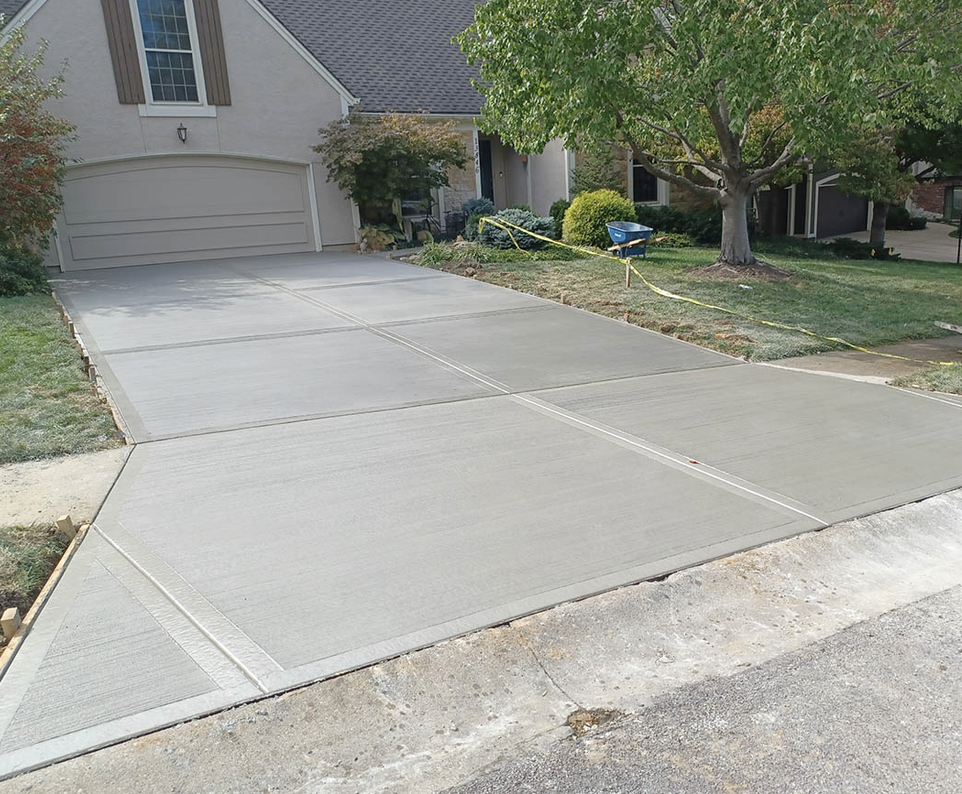
A driveway is mostly what you can't see
The finish is what visitors notice, but the life of a driveway is decided underneath it. Loose Florida sand moves under load, so the subgrade has to be graded and compacted before forms go in. Skip that and the slab ends up bridging soft spots — which is where mid-panel cracks start.
We set slab thickness and reinforcement for the vehicles that will actually use the drive. A daily commuter car is a different slab than a truck with a boat trailer or an RV pad.
Slope, drainage and where the water goes
Jacksonville gets intense rain in short bursts. Before we pour, we plan the slope so runoff moves away from the garage and the foundation rather than pooling at the apron or washing out a slab edge.
Downspouts, existing swales and the street apron all factor in. These are decisions that have to be made before forming, not corrected afterward.
Finish options
Most Jacksonville driveways are a broom finish: durable, good traction wet, and the most cost-effective choice. If you want more, colored concrete, exposed aggregate, saw-cut patterns and stamped borders are all available.
- Broom finish — the practical default, easy to maintain
- Colored or integral-tint concrete for a warmer look
- Exposed aggregate for texture and grip
- Stamped borders or saw-cut patterns to break up a large expanse
Control joints in the right places
Concrete shrinks as it cures, and it will crack. Control joints are cut at planned spacing and depth so those cracks land inside the joints where you don't see them. Joint layout also works around tree roots and drive geometry.
How a new driveway goes in, step by step
Every driveway follows the same sequence, and each step depends on the one before it. Knowing the order also helps you plan around the work: most of the visible activity happens over a couple of days, but the slab needs time afterward before it carries a car.
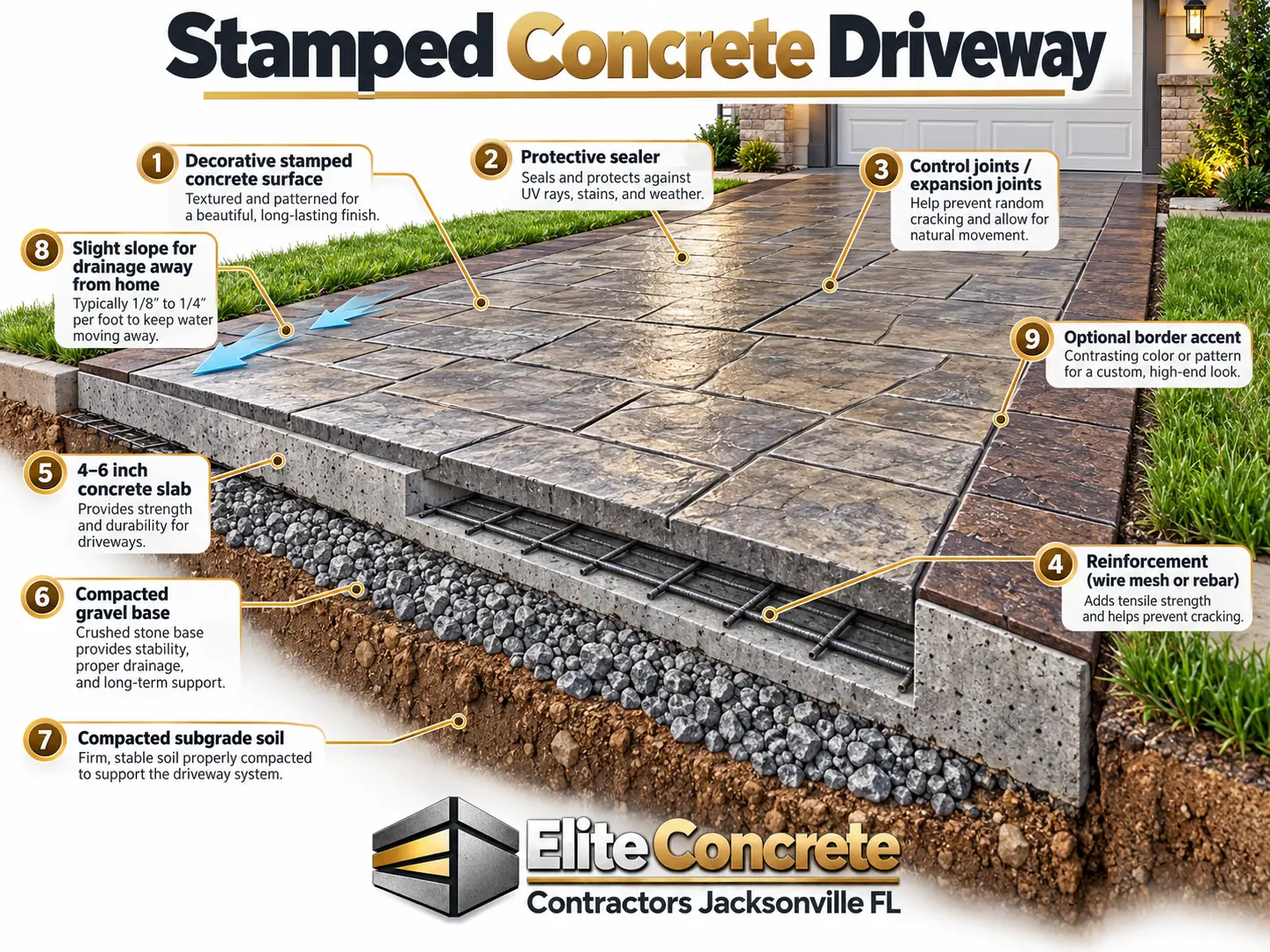
The cutaway below shows the layers that end up under a finished slab. The surface is the only part you see; the base, compaction and reinforcement underneath are what keep it flat and in one piece.
- Measure, mark utilities and confirm the layout, slope and any permit requirements for your property
- Remove the old surface or sod and excavate to the planned depth
- Grade and compact the subgrade, adding base material where the native sand is soft
- Set forms and reinforcement sized to the vehicles that will use the drive
- Pour, screed and float the concrete, then apply the finish you chose
- Cut control joints at planned spacing once the slab can take a saw
- Cure the slab and keep traffic off it until it has gained enough strength
Built for Jacksonville weather
Northeast Florida doesn't have freeze-thaw cycles, but it has its own set of problems. Summer afternoons are hot, and fresh concrete that loses moisture too fast can develop surface crazing and weak spots. On hot days we schedule pours early, keep the surface damp while finishing and plan curing so the top of the slab doesn't dry out ahead of the rest.
Heavy summer storms are the other factor. A pour needs a dry window, so scheduling sometimes shifts around the forecast. Once the slab is in, the slope and joint plan you agreed on do the long-term work of moving water away from the garage and keeping it from undermining slab edges.
Near the coast, salt air and sandy soils also matter. A good base, proper thickness at the edges and a quality sealer on decorative finishes all help the surface hold up.
When you can drive on it, and early care
You can usually walk on a new driveway within a day or so. Passenger cars typically wait about a week, and heavier vehicles such as trucks, trailers or an RV should wait longer. We'll give you the specific timeline for your mix, thickness and the weather at the time of the pour.
For the first few weeks, avoid parking heavy loads right at the slab edges, don't let a dumpster or moving truck sit on it, and hose off any spills rather than letting them soak in.
- Rinse the surface a few times a year to remove sand, leaves and tire marks
- Reseal decorative, colored or stamped finishes every two to three years
- Keep sprinklers and downspouts from constantly soaking one spot
- Call early if you notice a crack widening or a panel starting to settle
Replace, widen or extend?
Not every tired driveway needs to come out. If the base is sound and the damage is cosmetic, resurfacing or repair may be the better value. If panels have sunk, cracked through, or were poured too thin, replacement is usually the long-term fix. Widening for a third car or adding a side parking pad is common too — we tie the new section in with a planned joint so the old and new concrete can move independently.
On the free quote visit we'll look at the existing slab and tell you plainly which option makes sense.
Questions
Concrete Driveways in Jacksonville, FL FAQs
Related concrete services
Call Now for a FREE Quote & Service Availability
Call now for a free quote and service availability. 7 Days • 7AM–11PM.
Please have your 5-digit ZIP code ready.